


Public Safety in the 46th Ward
The 46th Ward has experienced meaningful improvements in public safety, particularly in violent crime and shooting-related incidents. These improvements reflect the combined effects of Alderwoman Clay's leadership and advocacy for consistent police-community engagement, targeted police activity, violence prevention, community involvement, improved coordination among agencies, and sustained attention to problem areas.
In 2025, the 46th Ward office saw significant year-over-year reductions in violent crime victimizations across the ward, including a 50% decrease in homicide victimizations, a 100% decrease in fatal shooting victimizations, and a 77% decrease in non-fatal shooting victimizations. The ward also reported reductions in robberies, aggravated batteries, and vehicular hijackings.

Figure 1: City of Chicago, Mayor’s Office of Community Safety - Violence Reduction Dashboard
https://www.chicago.gov/city/en/sites/vrd/home.html
Data note: Chicago's public crime data are drawn from the Chicago Police Department’s (CPD's) CLEAR system and are updated regularly. Reported incidents can be preliminary and may change as investigations continue. The 19th District covers areas beyond the 46th Ward, so district-wide statistics should not be represented as exclusively 46th Ward statistics.
A Safer Ward Requires Community Collaboration
The decline in serious violence demonstrates that progress is possible when government, law enforcement and neighbors work together. The most important task going forward is to preserve that progress while addressing the remaining crime and quality-of-life concerns that neighbors report.
Some ways the 46th ward has achieved addressing community safety conversation and cultivating community collaboration are the following:
-
Maintaining regular communication between neighbors, the 46th Ward Office, the Chicago Police Department (CPD), Community Alternative Policing Strategies, District Councils and other public safety partners plays an important role in community safety.
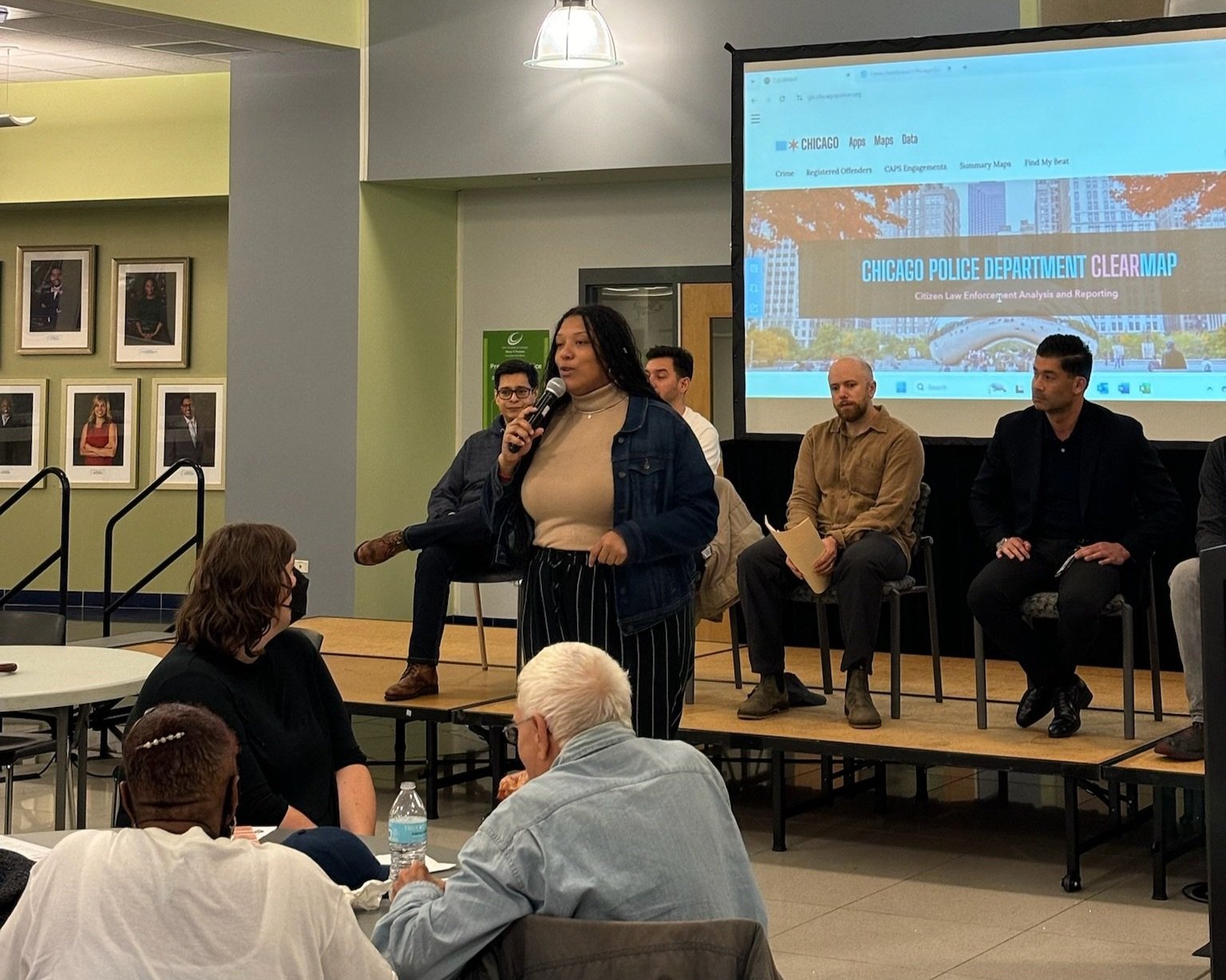
This is also achieved by hosting quarterly Community Conversation Events where our community safety partners and local organizations engage neighbors and address community safety questions.
In 2025, the 46th Ward Office reported attending more than 40 Beat and CAPS meetings and between 19th and 20th District Council 12 each monthly meetings, throughout the ward. These meetings provide an opportunity for neighbors to identify recurring problems, share information with officers, discuss crime patterns, and request additional attention to specific locations. Monthly meetings with the Cook County State’s Attorney's Community Justice Center plays an important role in information gathering. Along with engaging in the Commission for Public Safety and Accountability (CCPSA) meetings.
The ward continues to encourage neighbors to participate in CAPS and Police District Council meetings, creating a more direct line of communication between neighbors and law enforcement.
-
Crime is not evenly distributed throughout the 46th Ward. A relatively small number of locations can account for a disproportionate share of incidents.
Effective public safety therefore requires identifying where crimes are occurring, when they are occurring, and what types of offenses are involved, then directing appropriate resources toward those areas.
CPD's CompStat system and public crime data allow police and community leaders to monitor trends and adjust strategies. The 19th District Council also provides neighbors with access to CPD crime and incident dashboards and CompStat information.
The improvement is particularly significant when looking at violent crime.Citywide, Chicago reported substantial reductions in several serious crime categories during 2025, including murders, shooting incidents, shooting victims, robberies, motor-vehicle thefts, criminal sexual assaults and vehicular hijackings, and aggravated assault.
The 46th Ward's reductions in homicide and shooting victimizations are consistent with this broader citywide improvement, although ward-level and district-level numbers should always be evaluated separately. The work of the community group organization Communities Partnering 4 Peace (CP4P) has played a very important part in helping in reducing the violent our the ward.
CPD's All Area Alder's Meetings gives the Ward Offices crime statistics, an give a perspective on what has been occurring and what their strategy has been during that time and what it will be moving forward. CPD's two part yearly Community Safety Strategy Meeting that they host is geared towards bring the community together at large, to hear what their concern are and what they would like to see focused on for the coming year.
-
Public safety is not solely a policing issue. Long-term crime reduction also depends on reducing the conditions that allow violence and disorder to take root.
Alderwoman Angela Clay has emphasized a multifaceted approach that includes violence prevention, housing, employment opportunities, youth programs, mental-health resources, safe public spaces, schools, businesses, churches and community organizations. The office finds that doing business walk-through visits helps to enhance this message too.
The ward has continued to use community events, youth engagement, neighborhood activities and partnerships with community organizations as opportunities to build relationships and create positive alternatives for young people.
Neighbors Are Part of the Public Safety Strategy
neighbors play an important role in keeping crime down.
The 46th Ward encourages neighbors to:
Report crimes and emergencies promptly through 911.
Participate in CAPS and Beat meetings.
Report abandoned vehicles, lighting problems and other quality-of-life concerns through 311.
Register security cameras with CPD.
Participate in community safety conversations.
Share information about recurring crime patterns with the ward office and police.
Support neighborhood organizations and violence-prevention initiatives.
The ward office specifically identifies camera registration, improved lighting, CAPS participation and communication with CPD as important components of its public safety strategy.
The Bottom Line
The improvement in public safety is the result of sustained, coordinated public safety work.
However, the work is not finished. Crime can fluctuate from month to month, and certain offenses or locations can continue to experience increases even while overall violent crime declines.
We must continue the strategies that are working like community investment and violence prevention, identify emerging problems early, and maintaining strong partnerships between neighbors, CPD, and community organizations.
Community Safety
The 46th Ward office is committed to ensuring a safe and resourceful community for everyone in the 46th Ward. Below we’ve included a number of resources for how to engage and be a part of building a safer community:-
Beat meetings are hosted by the Chicago Police Department and held in each patrol beat. A full schedule of meetings can be found in the links below. Beat meetings are open to the public and you are welcome to attend any beat meeting held in your district to speak with officers.
Find My District, Beat, or Station
-
19th Police District Council
20th Police District Council
Anna Rubin – Chair - Anna.Rubin@cityofchicago.org
Darrell Dacres – Nominating Committee Darrell.Dacres@cityofchicago.org
Deirdre O’Connor – Community Engagement Deirdre.OConnor2@cityofchicago.org
-
Communities Partnering 4 Peace (CP4P)
CP4P employs community-based violence prevention solutions. CP4P works directly with individuals at high risk of shooting or being shot. They accomplish this by developing authentic, trusted relationships in communities, and by providing trauma-informed wraparound services. Their outreach workers are capable, skilled, and dedicated professionals who live and work in the communities they serve. They offer a series of comprehensive programs designed to intervene in gun violence as it happens, provide wraparound services, and build trust and communication within the communities to prevent future violence.
-
In Chicago, quiet hours are observed between 10 PM and 8 AM in areas within 600 feet of a residential district.
During these hours, activities involving the loading, unloading, handling of boxes, crates, containers, building materials, garbage cans, dumpsters, or similar objects should be carried out in a way that does not cause a noise disturbance. These activities must be avoided between 10 PM and 7 AM.
Motorized equipment, such as those used at construction sites, are prohibited from operating between 8 PM and 8 AM.
Please note that City of Chicago work, including water and sewer main projects or road construction, as well as emergency private utility work, is exempt from the noise ordinance.
If you encounter a situation that requires immediate attention, please dial 9-1-1.
For any questions or concerns, feel free to contact us at info@46thward.com
-
Public safety is a top priority in the 46th Ward, and keeping our community safe requires everyone working together. Here’s how you can help:
When a Crime Occurs
Call 911 immediately and file a police report. You can do this in person at 850 W. Addison St, 5400 N. Lincoln, online, or over the phone. Be sure to keep your R.D. number for follow-ups.
If you witness a nonviolent mental health crisis, 911 calls between 10:30 AM and 4 PM are redirected to Chicago’s CARE team for specialized support.
Reach out to our office or the 19th or 20th District CAPS Office for updates on crime trends, community safety efforts, or specific cases.
After a Crime Occurs
Stay informed by following cases through the court system with our office or the Clerk of the Circuit Court of Cook County at (312) 603-5030.
Participate in the court advocacy program to show community impact at hearings.
Check the Cook County Sheriff’s website for offender custody status.
Before a Crime Occurs
Attend police beat meetings and engage in discussions with CPD on safety trends.
Register your security cameras with CPD to help solve crimes in your neighborhood.
Businesses can apply for security camera rebates through the Lakeview Roscoe Village Chamber of Commerce.
Sign up for Smart911 to receive alerts and share key household information with emergency responders.
Report streetlight outages to 311, as well-lit areas deter crime.
Stay updated by following the 19th or 20th District CPD on social media and signing up for the office’s public safety newsletter.
How Our Office Supports Public Safety
Alderwoman Clay’s office serves as a direct line of communication between residents, CPD, the State’s Attorney’s Office, and community organizations. The office advocates for:
Increased police presence when necessary.
Safer infrastructure through the $1.5 million Menu Budget.
Legislation that prioritizes community safety.
When to Call 911 vs. 311
911: For emergencies, crimes in progress, or immediate threats.
311: To report abandoned vehicles, streetlight outages, or non-emergency issues.
Public safety is a collective effort. Stay informed, stay engaged, and work together to keep the ward safe.
-
Your safety and the safety of those around you are my top priority. If you or someone else is in immediate danger, please call 9-1-1. Below are resources to address various public safety concerns in our community.
Police Updates The Chicago Police Department (CPD) has the most accurate and up-to-date information on ongoing criminal investigations. For updates, I encourage you to reach out directly to your local Community Alternative Policing Strategy (CAPS) office. If you have questions or information about a safety-related incident, contact:
19th District CAPS: 312-744-8320
20th District CAPS: 312-742-8714
Area 3 Detectives: 312-744-8261
Mental Health Crisis
If you or someone you know is experiencing a mental health crisis, you can call 9-1-1 or 9-8-8 for immediate support. Calling 9-1-1 will connect you to a team including a police officer, paramedic, and social worker (availability may be limited). Calling 9-8-8 connects you to a local social service organization, with teams available 24/7 to assist.
Domestic or Gender-Based Violence
If you or someone you know is experiencing domestic violence, please don’t hesitate to reach out. Call the Domestic Violence Hotline at 800-799-7233 or text BEGIN to 88788 for support and resources.
Hate Crimes
The Chicago Commission on Human Relations offers support to victims of hate crimes while the CPD investigates. To report a hate crime, contact the Commission at 312-744-4111.
Fire Safety
It’s important for all residents to have working smoke alarms in their homes. If you’re a tenant and notice a malfunctioning or missing smoke alarm, learn more about the requirements. Homeowners needing assistance with acquiring or installing smoke alarms can call 3-1-1 for referrals.
Complaint Against a Police Officer
The Civilian Office of Police Accountability (COPA) investigates complaints against police officers for misconduct. If you wish to file a complaint, please contact COPA at 312-743-2672.
Get Involved Here are a few ways you can actively contribute to violence prevention and community safety:
Alliance of Local Service Organizations (ALSO)
ONE Northside
Moms Demand Action – Lincoln Square Chapter
CAPS meetings
Police District Council meetings
Court Advocate program
Let’s work together to keep the 46th Ward safe for everyone. If you have any concerns or need assistance, please don’t hesitate to reach out. Stay safe, and remember, we're stronger when we come together as a community.
-
The Living Room: Forever Hope 4423 N Ravenswood Ave, Chicago, IL 60640
Thresholds offers mental health crisis support through The Living Room – Forever Hope on the north side of Chicago. It is an entirely peer-led mental health crisis respite center, an alternative to psychiatric hospitalization. The Living Room at Thresholds is a comfortable, safe, and quiet place for those experiencing a mental health crisis. This program is run for those in recovery, by those in recovery.
-
Available via 911 throughout the city, the CARE team seeks to ensure that individuals experiencing a mental health crisis are assisted by teams of behavioral health professionals, with resources to address their unmet health and social needs. When the CARE team responds to an individual in crisis they offer de-escalation, mental health assessment, referrals to community services, and transport to community-based destinations as appropriate. The CARE team conducts follow-up at 1, 7, and 30 days with individuals that they connect to resources.
The CARE team responds to 911 calls with a mental health component deemed eligible Monday–Friday, 10:00 am–4:30 pm.
CARE eligible calls are calls with a mental health and socioemotional distress component but:
Have no weapons
Show no violent tendencies
Have no active substance use and no overdose
No active plan to take their life by suicide
No completed attempt to take their life
No medical issue
No active threat to themselves or others